
Moving Beyond the Download
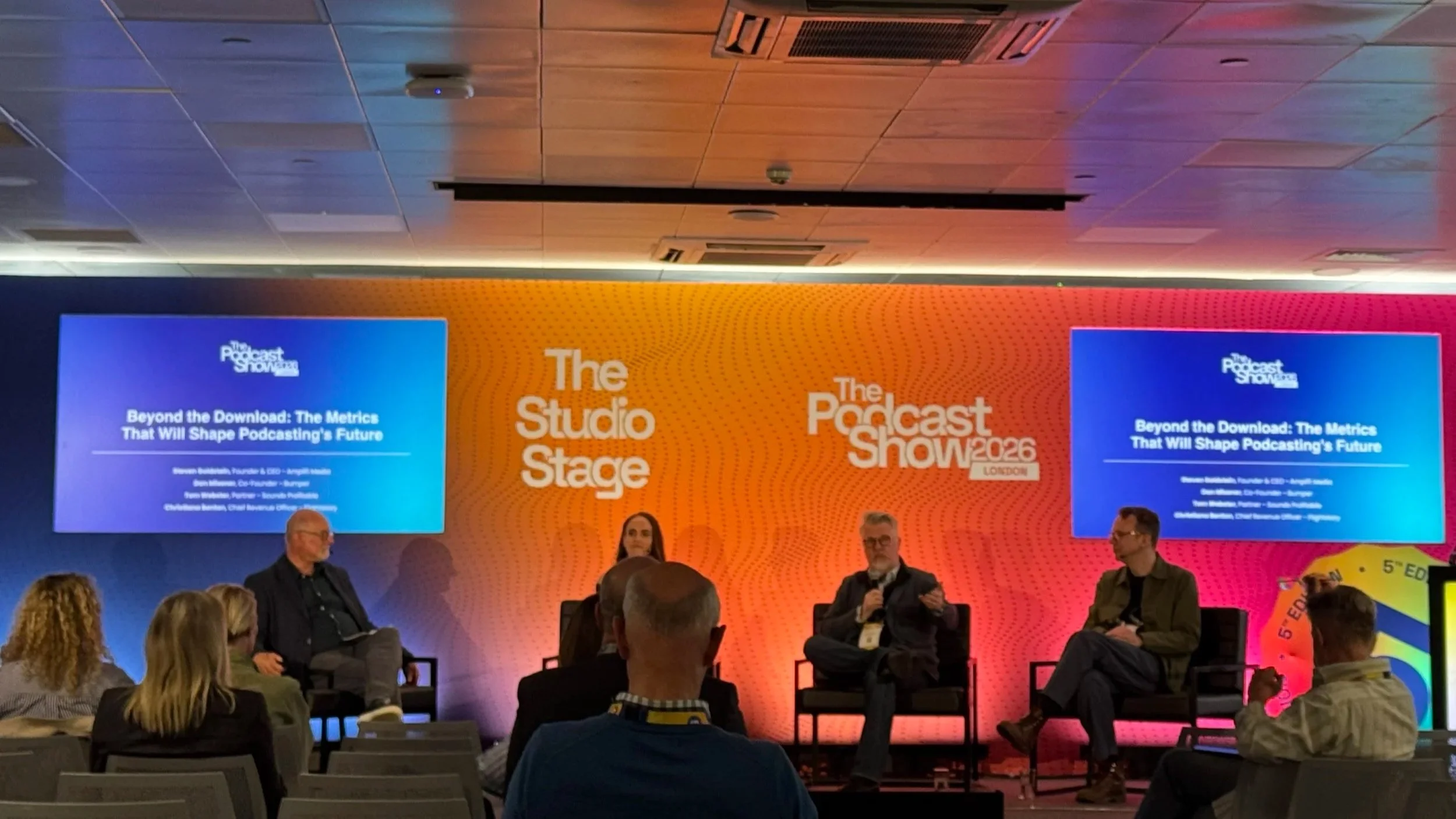
At The Podcast Show London last week, I moderated a panel called Moving Beyond the Download: The Metrics That Will Shape Podcasting’s Future, alongside Tom Webster from Sounds Profitable, Dan Misener from Bumper, and Christiana Brenton from FlightStory.
Our session began with a fairly simple question: is the download still enough for the podcast business as it evolves? But as the conversation unfolded, it became clear we were really talking about something much larger — the changing structure not just of podcasting, but of media itself.
The Metric That Built Podcasting Is No Longer Big Enough
For years, the download carried the podcast industry. It created a common currency when podcasting desperately needed legitimacy with advertisers and agencies. It standardized buying while giving creators and publishers a benchmark for success. In many ways, the download helped transform podcasting from an emerging medium into a serious business.
But increasingly, the download feels like a metric designed for an earlier version of the business.
The Download Conflates, and Often Inflates, Actual Consumption
A download is not necessarily a listen. In many cases, episodes are automatically delivered but never meaningfully consumed, sometimes overstating true engagement by 50% or more. So, while the download served as a useful blunt instrument during podcasting’s early growth phase, it increasingly struggles to reflect attention, playback, or actual time spent.
Tom made an important point during the discussion, noting the download is not meaningless. It is standardized, audited, and certified. As he put it, “The download is a transitional metric.”
That may be the right way to think about it. A download can confirm that a file was delivered. It does not necessarily tell us whether somebody listened. Or stayed. Or cared.
Distribution Is Not the Same Thing as Engagement
Compared to where podcasting stood even a decade ago, the business has actually evolved remarkably quickly in attribution, analytics, verification, and measurement standards.
Spotify emphasizes plays and streaming behavior. YouTube prioritizes views, retention, and watch time. Apple is moving deeper into streaming and video behavior. Every major platform now measures engagement differently because every platform is optimizing for a different form of audience attention.
People. Playback. Time Spent.
Dan and The Bumper team concentrate on three durable ideas: “We focus on people. We focus on playback. We focus on time spent.”
One company may call it a play. Another may call it a stream. Another may prioritize watch time or retention. But underneath all of those definitions are the same fundamental questions.
· Did real people engage?
· Did they intentionally choose the content?
· Did they spend meaningful time with it?
Dan’s point was not that the industry needs one shiny new metric to replace the download. It was that better measurement helps smart people make informed decisions about content, marketing, talent, renewal, investment, and growth.
The Bigger Story Is the Migration of Trust
Christiana widened the discussion beyond podcast mechanics and into the broader transformation happening across media and marketing.
From FlightStory’s vantage point working directly with advertisers and creator-led businesses, she said: “The only metric that matters is business growth.”
Christiana also described the larger shift as “an almost existential shift in power dynamics from institutions to trusted individuals.”
Creator-led media is no longer a side story or experimental buy. It is increasingly central to how brands create relevance, cultural connection, and consumer trust.
And when trust moves, measurement has to move with it.
Audiences Already Behave Like Platforms
As creator-led media accelerates, the shift is to attention, trust, and consumption patterns.
One of the most revealing parts of our discussion was how agency structures are scrambling to adapt to changing audience behavior. Audio sits in one department. Video sits in another. Social lives somewhere else entirely. But audiences do not consume media according to agency org charts They move fluidly from YouTube clips to full podcast episodes to newsletters to social feeds to streaming platforms.
During the panel, I mentioned something that stood out to me from this year’s television upfront presentations in New York. The major TV companies no longer describe themselves primarily as “networks.” Increasingly, they describe themselves as platforms.
In many ways, television is now wrestling with the same fragmentation, platform and measurement issues reshaping podcasting - TV channels, streaming channels, YouTube, apps etc.
All media is moving from channel-based thinking to Liquid Content based thinking.
Where Podcast Measurement Is Going
Tom captured the broader transition particularly well when he said, “You need to show that the prize on the other side is attractive. You need to show that the bridge is safe to cross. And you need to show that the ground people are standing on is crumbling.”
The future of podcast measurement is probably not one new number that magically replaces the download. Christiana’s comments point in that direction as well, the current systems are fragmented because the media environment itself is fragmented.
The download helped build podcasting. But the next phase of the industry will almost certainly be measured through a wider lens: people reached, intentional playback, time spent, trust created, and business impact delivered.
We must move beyond the download
Audiences no longer consume content in one place, on one device, or through one distribution system. That is a harder story to measure. It is also a much more important one.
Thanks to Dan, Christiana and Tom for a really great panel on a complicated topic.
Congratulations to the Podcast Show LDN on another great event.
If you were at The Podcast Show and missed this session, you were not alone. The panel was inadvertently omitted from the official Podcast Show app schedule, which unfortunately limited awareness. Fortunately, a recording of the session will be made available soon. We’ll let you know.