
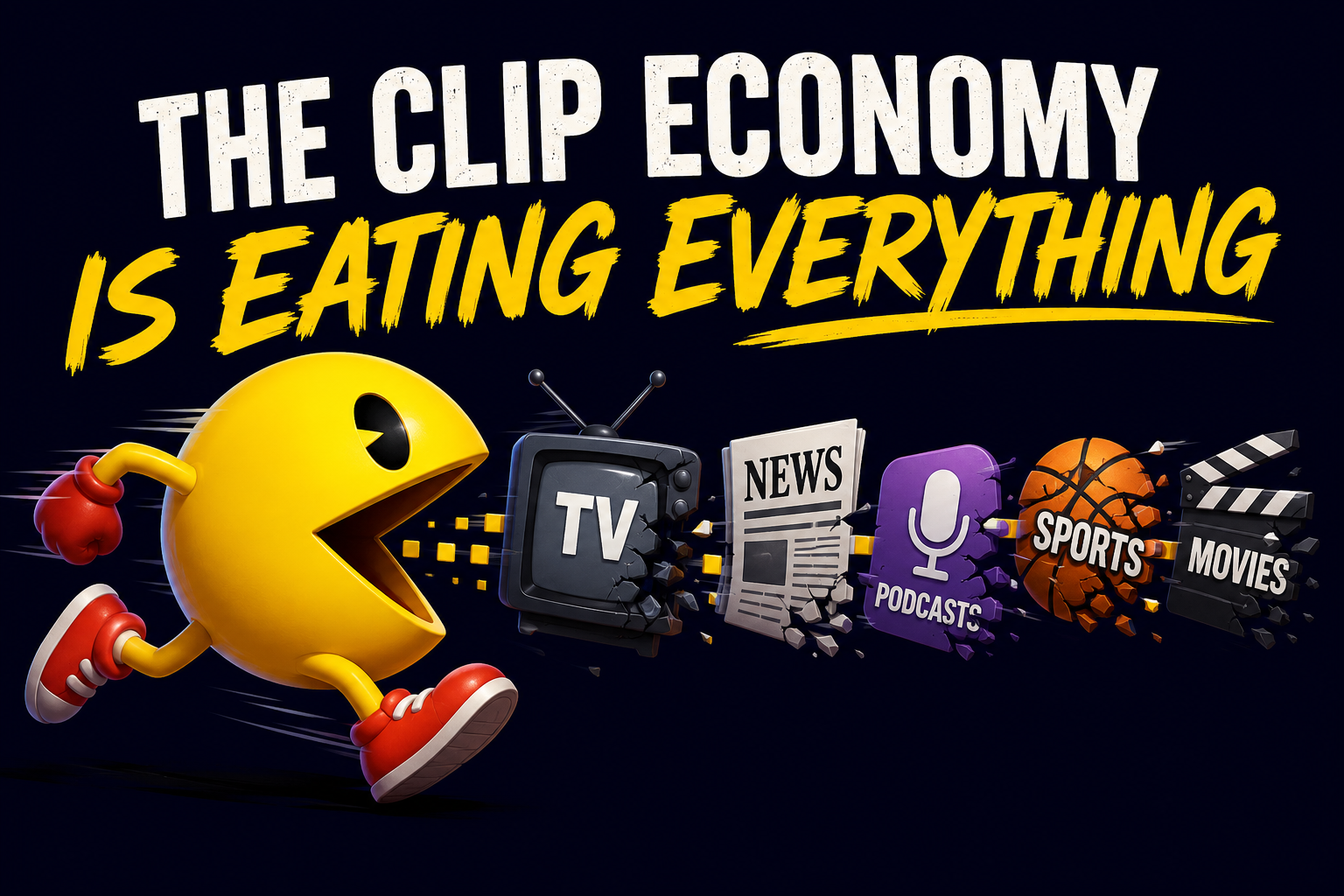
In 2026, clips are one of the primary ways people discover and consume podcasts.
For years, video clips were treated as marketing assets used to promote a full podcast, livestream, or episode. The teaser. The trailer. Instagram Reels and Stories. TikToks. Shorts. These clips were breadcrumbs meant to send people to the “real” thing.
That model has rapidly changed.
A podcast episode no longer lives in one format or destination.
Increasingly, the 45-second slice of video that lands on someone's phone at 9:47 p.m. is the product.
The episode is the raw material.
The Evidence Is Becoming Hard to Ignore
Clipping has fundamentally changed how people consume television, music, news, sports, entertainment, and podcasts. It is connected to podcasting’s Liquid Content era, where audio, video, and social media converge and audiences move fluidly across experiences.
Much of the discussion around clipping has been anecdotal. But new data makes the trend difficult to dismiss.
The Atlantic’s Charlie Warzel recently spoke with Prof G Markets co-host Ed Elson about this phenomenon. According to figures cited by Elson during his appearance on Galaxy Brain, a single month’s activity around the livestreaming platform Kick involved 1,737 active clippers producing more than 309,000 videos. One creator, the 20-year-old influencer Clavicular, reportedly generated 69,000 clips that accumulated more than 2.2 billion views across social platforms, while his original livestream averaged approximately 16,000 concurrent viewers.
The clips reached audiences exponentially larger than the original show.
Clipping Became an Industry
Maybe it was inevitable.
Love him or loathe him, Andrew Tate was among the first to recognize the power of organized clipping. Through Hustlers University, members were encouraged to clip his livestreams, distribute them widely, and earn commissions tied to resulting signups. The strategy transformed clips into both marketing and monetization.
Others noticed.
MrBeast later embraced what he called the “Tate Model,” launching Vyro to scale clipping operations for creators and brands. Reports suggest Vyro works with more than 1,000 clippers, paying roughly $50 per 100,000 views. The creator-economy platform Whop says clippers on its platform have driven more than $1.5 billion in client sales.
Clipping did not remain a creator hack. It became an industry.
For a growing segment of consumers, clips are not simply a way to discover content. They are the content.
Clips Are Not Just Short-Form Video
Short-form video is a content format. It is vertical, fast, and designed for scrolling.
Clips are different. A clip is usually extracted from something longer - a podcast episode, livestream, television interview, or news segment.
On Galaxy Brain, Elson described being approached by people who say, “Big fan. I don’t actually listen to the show, but I watch your clips.”
That comment resonated deeply because it mirrors what I have heard repeatedly from my NYU students. Many tell me they consume three or four clips from a podcast, assume those are the most important moments, and feel no need to seek out the full episode.
For many consumers, the center of gravity has shifted from the show to the clips.
Podcasts May Be the Perfect Clip Factory
Podcasting may be uniquely exposed to this shift because it naturally produces exactly what modern algorithms reward: personality-driven moments lifted from hours of conversation.
A two-hour podcast is no longer simply a two-hour podcast. It may be 20 pieces of content. The full episode is both a product and a content engine.
Are Clips Replacing the Show?
If clips are often the first point of contact, what happens to the full episode? This is arguably the most important question facing the business of podcasting today.
When clips outperform the show by 20, 50, or even 100 times, are they creating new audiences or replacing them?
The honest answer is probably both.
Some people will move from Shorts and Reels into deeper relationships with podcasters. Others will stop at the clip.
The clip may no longer be the gateway to the show. Increasingly, it may be the endpoint itself.
That reality is unsettling because loyal audiences have historically been the foundation of podcasting and ultimately, the base for revenue.
The Measurement Challenge
The clip economy also exposes what is already a growing podcast measurement problem.
If millions of people experience a podcast through fragments distributed in many places, what exactly are we measuring?
Downloads were never designed to measure fragmented consumption. As audiences spread across YouTube, Spotify, Apple, TikTok, and Instagram, understanding true reach and engagement becomes more difficult.
Can Podcast Clips Be Monetized?
Yes - but only if creators stop treating clips as promotional leftovers.
Not every person who watches a clip will subscribe to a show. But many listeners would never have discovered that show in the first place without the clip. And if a clip generates 250,000 views, it is more than promotion.
It is media inventory.
Many podcasters still operate with a 2021 mindset. They produce an episode, slice off a few clips as an afterthought, post them to social media, and hope they drive audiences back to the show.
The economics of clips are less mature than traditional podcast advertising. But attention has a way of attracting investment.
The opportunity increasingly lies in treating clips as sellable assets. Advertisers can be integrated directly into the viewing experience through visual sponsorships, lower-third graphics, branded frames, subtle product placement, end cards, and calls to action that travel with the clip wherever it is distributed.
Don’t just sponsor the podcast.
Sponsor the clip machine.
If clips are becoming products in their own right, they need business models of their own as well.
But reach without engagement is not a sustainable business model. Relationships - and ultimately revenue - are still built through deeper engagement.
Even Podcasting’s Pioneers See It Coming
Perhaps the clearest signal that this shift is becoming structural rather than experimental comes from one of podcasting’s pioneers.
Hernan Lopez, founder of Wondery, recently convened a conference dedicated entirely to vertical video. Think about that for a moment. One of the architects of modern podcasting is now helping the industry understand a format that barely existed a few years ago.
Vertical video is not replacing podcasting. It is becoming part of the ecosystem surrounding it.
The companies that thrive will not choose between long-form and short-form.
They will understand how the two work together.
Discovery and Depth
Podcasting became successful by asking people to slow down.
The clip economy asks them to speed up.
Both realities now coexist.
The creators and media companies that thrive in this environment will not reject the clip economy. They will embrace it - using clips to drive discovery while continuing to invest in the deeper experiences that build trust, loyalty, and habit.
Clips can generate reach.
Relationships create value.
And while the clip may increasingly be the front door to media, the relationship still happens inside the house.
Creators are monetizing clips. Podcasters should too.