
BLUF (Bottom Line Up Front)
Like, follow, subscribe, so you never miss an episode.
It’s the sign-off on nearly every podcast and YouTube video, and for years it was good advice. A follow felt like a promise: you post, your followers see it.
That deal has changed, and not just on TikTok and Instagram. YouTube, Spotify and Apple, where most podcast listening/viewing happens, have all loosened the link between a follow and what people actually see. Spotify now tucks the shows you follow behind a separate tab while its Home screen fills with recommendations. YouTube says only about 1 in 10 subscribers who see a new episode actually click on it. Apple stops downloading episodes for followers who drift away.
What Changed?
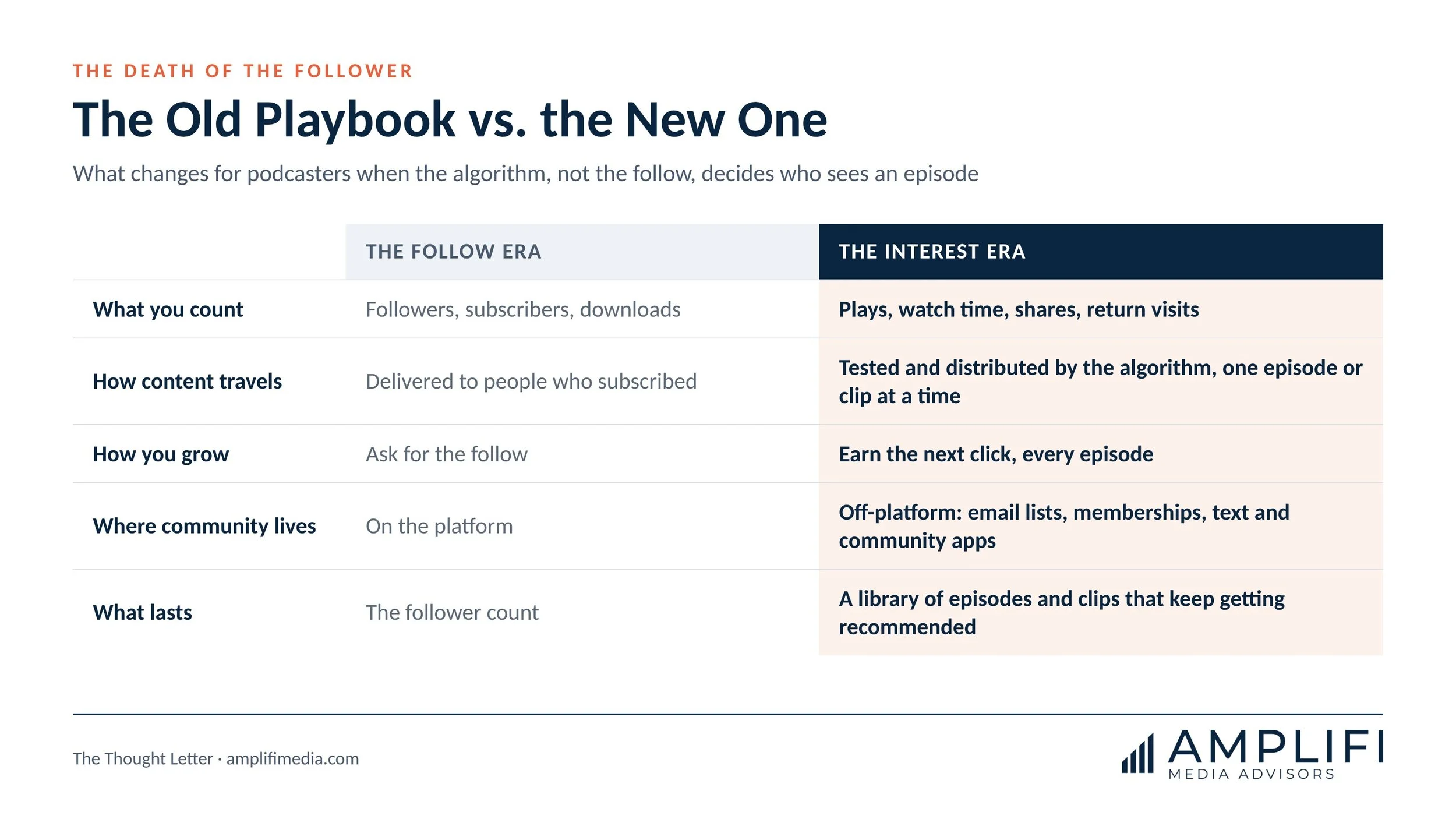
For most of social media’s history, feeds were built around the people you chose. Follow a friend or celebrity and their posts showed up in your feed. To break through as a creator, you built a following so you had an audience you could reach. The follow was a social contract.
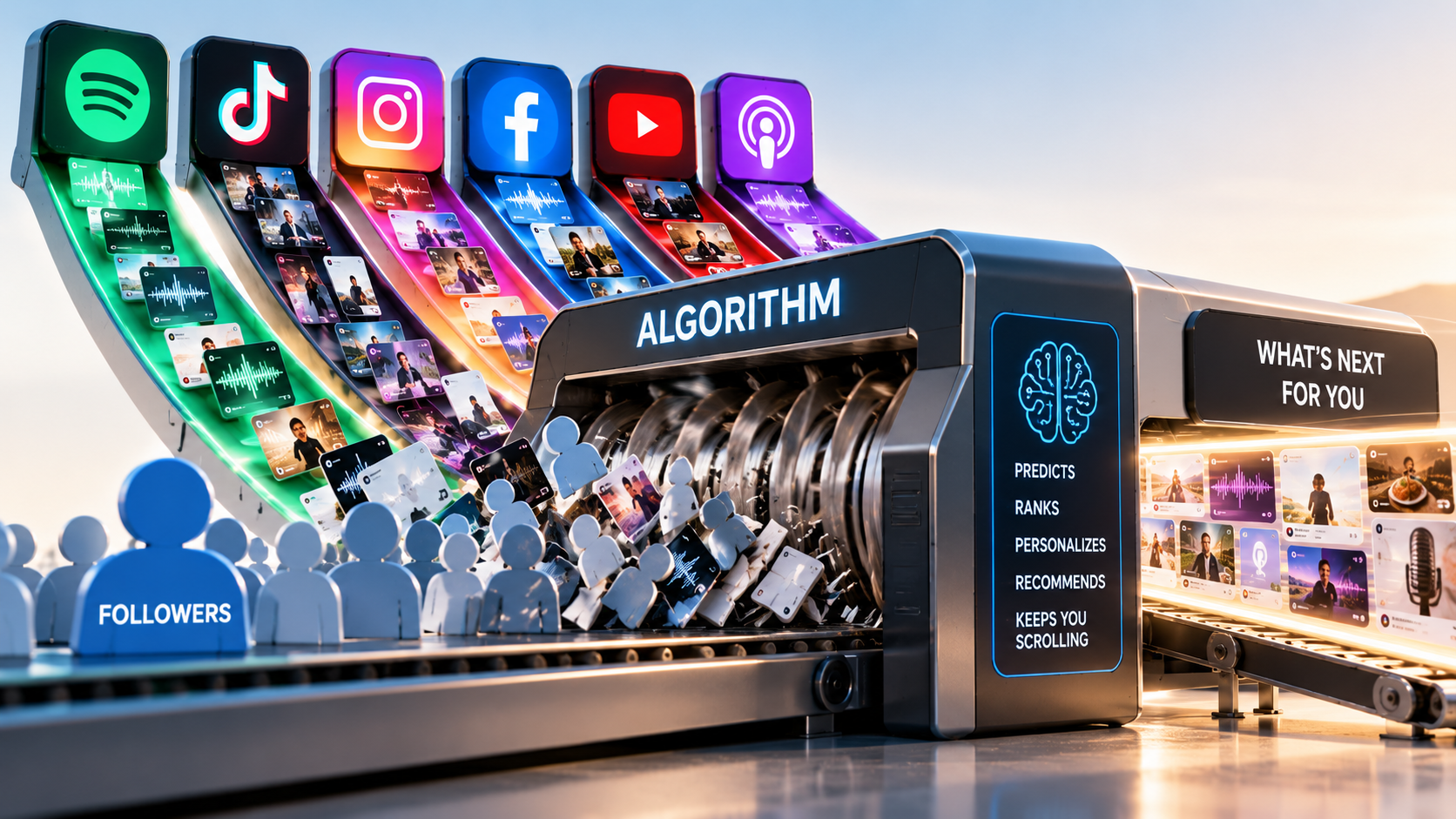
TikTok broke it. Its “For You” page serves up whatever holds your attention, from anyone. It worked so well that everyone followed. Instagram added Reels, YouTube added Shorts, and Facebook and X rebuilt their feeds around recommendations. I touched on this in my conversation with Hernan Lopez about vertical video. Some now call it “interest media.”
Patreon CEO Jack Conte calls it the death of the follower. On Taylor Lorenz’s Power User podcast, he described creators who spent years building a community and now can’t reach it when they post. “That’s insane,” he said. Conte’s not a neutral observer. Patreon does well when creators worry about losing their audience. But he is right.
YouTube: Algorithm Over Subscriber
YouTube is now the most-used platform for podcasts, and it said back in 2018 that recommendations drive 70% of watch time.
This September, Todd Beaupré, who runs growth and discovery at YouTube, told creators that even in the Subscriptions feed, most videos get a click-through rate of 10% or less. In his words, even on your best videos, “90% of the time your subscribed audience isn’t deciding to watch.”
Gulp.
And since April, subscribers who turned on “All” notifications but haven’t watched a channel in about a month no longer get push alerts on their phones.
Graham Litten of YouTube’s podcast team visited my NYU class recently, and my students asked about exactly this. What we heard lined up with what YouTube tells creators publicly:
• The algorithm rules. Recommendations are driven mainly by how viewers respond to each video: clicks, watch time and satisfaction.
• What about discovery on big screens? The push is on at YouTube to be on big TV’s and the algorithm adjusts as viewers tend to scroll or search rather than browse their subscriptions.
My takeaway: on YouTube, the relationship is now largely between the viewer and the video, not the viewer and the show. The subscriber count is a scoreboard, but is no longer the big engine.
What About Spotify?
Spotify has been heading the same direction, step by step:
• 2023. Spotify rebuilt its Home screen around TikTok-style vertical previews and recommendations.
• 2025. New episodes from shows you follow moved into a separate “Following” feed under Podcasts. Home started recommending podcasts instead.
• 2026. In March, Spotify announced it is retiring “What’s New,” where new episodes from your shows used to appear, and pointing people to Podcasts > Following.
Your followers can still find you. They just have to go looking. The home screen they open to is built around what Spotify thinks they’ll like, just like the Netflix home screen.
It’s also worth remembering that Spotify never automatically downloaded new episodes the way RSS apps did. A Spotify follow has always been closer to a bookmark than a delivery.
Apple: Still the Strongest Follow, but Softer
RSS was always one of the strongest follows in media. Subscribe to a show and new episodes arrived on your phone. Apple Podcasts still works mostly that way, but the rules have been changing here, too.
• 2021. Apple changed “Subscribe” to “Follow” in iOS 14.5 as it prepared to launch paid podcast subscriptions.
Apple’s change is housekeeping. It stops delivering to people who already left, which makes the numbers more honest. But it confirms the point. A follower who isn’t listening isn’t really an audience.
Apple still rewards follows. It says “the more followers and engagement, the higher a show’s chart position.” That’s one reason some publishers have bought them. After a Bloomberg story about Apple followers sold for $5 apiece through mobile game ads, Bumper’s Dan Misener put it simply: “You can buy traffic. You can’t buy audience.” We’ve been telling our clients this for years: follower counts aren’t the same as audience size.
Social Media Got There First
If you want to see where this is heading, look at social media. Gaining followers was never really the point on TikTok. quso.ai analyzed about 31,000 creator posts and found the For You feed delivered 85% of views. The “Following” feed? 0.3%. That’s not a typo.
At Meta, recommended posts from accounts people don’t follow went from about 15% of the Facebook feed in 2022 to about 40% of everything people see on Instagram a year later. At the FTC antitrust trial, Meta’s own chart showed time spent on friends’ posts falling to 7% on Instagram. The New Yorker headline: “Mark Zuckerberg Says Social Media Is Over.”
Instagram said it expanded “Your Algorithm,” a feature that lets people pick the topics they want more or less of. In announcing it, Adam Mosseri, who runs Instagram, wrote that “who you follow used to be a meaningful tool people had for shaping their own experience.” That tool, he said, “quietly stopped working.”
The Platforms Have Other Priorities
So why is this happening? Platforms want people to keep scrolling, watching, and coming back, so they optimize for what drives their business. Their algorithms recommend the content that will accomplish that, even if it’s a creator you’ve never heard of.
Today podcasters are just supplying the content but don’t control who sees it.
What Happens Now
I’m not saying stop asking people to follow. It still helps, especially on Apple, but far less. A few suggestions:
• Ask for the listen or watch, not just the follow. Tell people what’s coming and why they shouldn’t miss it. “On Tuesday’s episode we’ll find out…” is more compelling than “Hit follow.”
• Make every episode earn the next one. A strong tease, recurring feature, or unanswered question can build an audience habit. On every platform, people who keep listening keep getting your episodes.
• Build direct relationships. Ask for an email address or to join your membership program. Don’t make platforms the only way to reach your audience. Arielle Nissenblatt has been pushing the development of email databases and she is correct.
• Stop leading with follower and download counts. Show advertisers how many people actually consume your content and how often they return.
Followers Were Never the Audience
For a long time, we treated followers and audience as the same thing. They never were.
I see it with this newsletter. In addition to it being on my website, and my own email database, The Thought Letter is also published on LinkedIn. People deliberately subscribed, expecting to receive each issue. But according to our analytics, those posts reach only 40% to 60% of the people who asked for them. These readers have already told us they’re interested, yet we can’t count on LinkedIn to put our content in front of them. Podcasters face the same challenge on YouTube, Spotify and, increasingly, Apple.
Bottom line - Sadly, don’t count on the follow button. Today, the algorithm supersedes it.